Building AI Agent Pipelines: Architecture Patterns
- Posted on May 10, 2025
- cloud, engineering, AI, agentic, architecture
- By Carlos Camacho
As AI agents move from research prototypes to production systems, the question shifts from “can it work?” to “how do we architect it?” Building reliable agent pipelines requires patterns that handle failure, maintain state, and compose multiple agents into coherent workflows. In this post, we explore the architecture patterns that make agent pipelines production-ready.
Why Pipelines?
A single AI agent can handle a single task, but real-world problems rarely fit into a single step. Consider a code review pipeline:
- An agent reads the diff and identifies changed files
- Another agent analyzes the changes for potential bugs
- A third agent checks for style and convention violations
- A fourth agent synthesizes the findings into a review comment
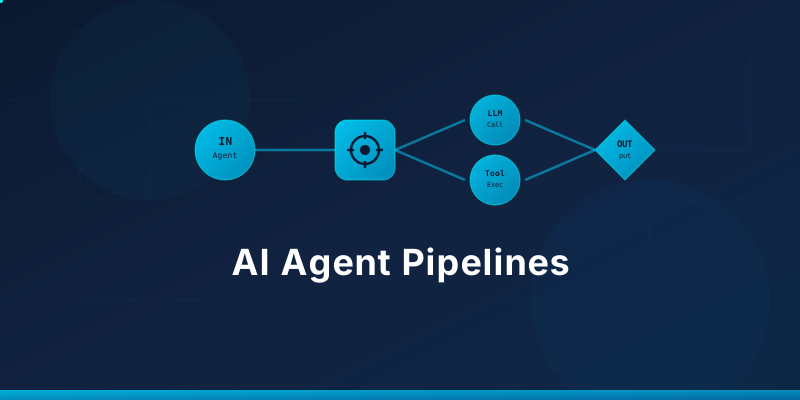
Each step requires different context, different tools, and potentially different models. A pipeline orchestrates these steps into a reliable, repeatable workflow.
Pattern 1: Sequential Pipeline
The simplest pattern chains agents in sequence, where each agent’s output becomes the next agent’s input.
Agent A → Agent B → Agent C → Result
When to use: When each step depends on the previous step’s output and the order is fixed.
Example: A documentation generator that:
- Reads source code and identifies public APIs
- Generates documentation for each API
- Formats and assembles the final document
Trade-offs: Simple to implement and debug, but slow — total latency is the sum of all steps. A failure in any step blocks everything downstream.
Pattern 2: Parallel Fan-Out / Fan-In
Multiple agents work on independent sub-tasks simultaneously, and their results are combined.
         ┌─→ Agent B ─┐
Agent A ─┤             ├─→ Agent D
         └─→ Agent C ─┘
When to use: When sub-tasks are independent and can be processed concurrently.
Example: A security audit pipeline that simultaneously:
- Scans for dependency vulnerabilities
- Analyzes code for injection risks
- Reviews configuration files for exposed secrets
Trade-offs: Faster than sequential, but requires careful result merging. The fan-in agent (Agent D) must handle partial failures — what happens if one branch fails but others succeed?
Pattern 3: Router / Dispatcher
A routing agent examines the input and dispatches it to the appropriate specialized agent.
              ┌─→ Bug Fix Agent
Router Agent ─┤─→ Feature Agent
              └─→ Refactor Agent
When to use: When different inputs require fundamentally different processing strategies.
Example: An AI coding assistant that routes requests differently based on whether the user wants to fix a bug, add a feature, or refactor existing code.
Trade-offs: Highly flexible, but the router itself becomes a single point of failure. A misrouted request can produce subtly wrong results that are hard to detect.
Pattern 4: Iterative Refinement Loop
An agent generates output, an evaluator checks it, and if it doesn’t meet criteria, the agent tries again with feedback.
Agent → Evaluator → [Pass] → Result
  ↑         │
  └─[Fail]──┘
When to use: When quality matters more than speed and you have clear evaluation criteria.
Example: A code generation pipeline where:
- An agent generates code from a specification
- The code is compiled and tests are run
- If tests fail, the agent receives the error output and tries again
- The loop continues until tests pass or a retry limit is reached
Trade-offs: Can produce high-quality output, but may loop indefinitely without good stopping criteria. Each iteration adds cost and latency.
Pattern 5: Supervisor / Worker
A supervisor agent manages a pool of worker agents, assigning tasks, monitoring progress, and handling failures.
         Supervisor
        /    |    \
  Worker  Worker  Worker
When to use: When you need dynamic task allocation and the number of sub-tasks isn’t known in advance.
Example: A large-scale code migration where the supervisor:
- Scans the codebase and identifies files that need migration
- Assigns each file to a worker agent
- Monitors worker progress and reassigns failed tasks
- Aggregates results and generates a migration report
Trade-offs: Highly scalable, but complex to implement correctly. The supervisor must handle worker failures, timeouts, and conflicting changes.
Implementation Considerations
State Management
Every pipeline needs a strategy for passing state between agents. Options include:
- Message passing: Each agent receives and returns structured messages. Simple but limited in size.
- Shared context store: A central store (database, file system) where agents read and write. More flexible but introduces coordination challenges.
- Event sourcing: Every action and result is recorded as an event. Provides full auditability but adds complexity.
Error Handling
Agent pipelines fail in ways that traditional software doesn’t:
- Hallucination: An agent produces confident but incorrect output
- Timeout: An LLM call takes too long or gets rate-limited
- Drift: An agent goes off-track on a long task
- Conflict: Two agents make conflicting changes
Design your pipeline with these failure modes in mind. Use retries with exponential backoff, set hard limits on iterations, and always have a human escalation path.
Observability
You can’t debug what you can’t see. Every agent pipeline needs:
- Structured logging of all agent inputs and outputs
- Tracing across agent boundaries (distributed tracing)
- Metrics on latency, cost, and success rate per step
- A way to replay failed pipelines with the same inputs
Choosing the Right Pattern
There’s no universal best pattern. The right choice depends on your specific requirements:
| Pattern | Best For | Avoid When |
|---|---|---|
| Sequential | Simple, ordered workflows | Latency is critical |
| Fan-Out/In | Independent sub-tasks | Results are tightly coupled |
| Router | Diverse input types | Classification is ambiguous |
| Iterative | Quality-critical output | No clear evaluation criteria |
| Supervisor | Dynamic, large-scale tasks | Simple, predictable workflows |
In practice, production pipelines often combine multiple patterns. A supervisor might dispatch work to sequential sub-pipelines, each of which contains an iterative refinement loop. The key is to start simple and add complexity only when the problem demands it.
Conclusion
Building AI agent pipelines is an emerging discipline that borrows from distributed systems, workflow orchestration, and software architecture. The patterns described here provide a starting point, but the field is evolving rapidly. The engineers who master these patterns will be well-positioned to build the next generation of AI-powered systems.
Responses
Want to leave a comment? Visit this post's issue page on GitHub (you'll need a GitHub account. What? Like you already don't have one?!).