
Multi-Agent Systems: When One AI Isn't Enough
- Posted on February 12, 2026
- cloud, engineering, AI, agentic, architecture
- By Carlos Camacho
A single AI agent can write a function, fix a bug, or answer a question. But what about redesigning an entire microservice architecture? Or migrating a million-line codebase to a new framework? These tasks exceed what any single agent can handle — not because the model isn’t smart enough, but because the context is too large, the concerns too diverse, and the coordination too complex. Enter multi-agent systems.
Why Multiple Agents?
The case for multi-agent systems comes down to three factors:
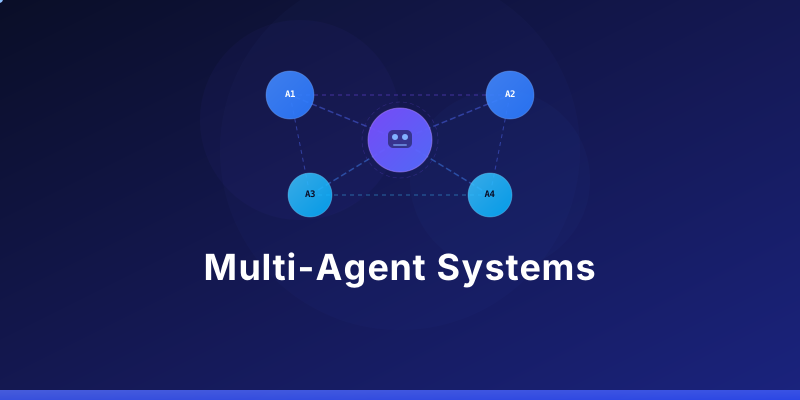
1. Context Window Limitations
Even the largest language models have finite context windows. A single agent working on a large codebase quickly runs out of context space. Multiple agents can each focus on a subset of the problem, keeping their context focused and relevant.
2. Specialization
Different tasks require different expertise. A security audit agent needs different knowledge than a performance optimization agent. By specializing agents, you can give each one a focused system prompt, relevant tools, and domain-specific knowledge.
3. Parallelism
Some tasks are embarrassingly parallel. Reviewing 50 files doesn’t require reviewing them in sequence — 50 agents can review them simultaneously, reducing wall-clock time from hours to minutes.
Multi-Agent Topologies
Flat Collaboration
All agents are peers with equal authority. They communicate through shared state (a file system, a database, a message queue) and coordinate through conventions rather than hierarchy.
Agent A ←→ Agent B ←→ Agent C
    ↕                    ↕
         Shared State
Pros: Simple, no single point of failure. Cons: Coordination is difficult, agents can conflict.
Hierarchical (Supervisor-Worker)
A supervisor agent manages a team of worker agents. The supervisor decomposes the task, assigns sub-tasks, collects results, and handles conflicts.
        Supervisor
       /    |     \
  Worker  Worker  Worker
Pros: Clear coordination, handles complex tasks well. Cons: Supervisor is a bottleneck and single point of failure.
Assembly Line
Each agent handles one phase of a multi-phase process. Output from one agent feeds directly into the next.
Agent A → Agent B → Agent C → Agent D
(Plan)   (Implement) (Test)  (Review)
Pros: Clear responsibilities, easy to debug. Cons: Rigid, slow if phases can’t overlap.
Debate / Adversarial
Multiple agents tackle the same problem independently, then a judge agent evaluates their solutions and picks the best one (or synthesizes a hybrid).
Agent A ──┐
Agent B ──┼──→ Judge → Result
Agent C ──┘
Pros: Reduces individual bias, catches more edge cases. Cons: Expensive (multiple full implementations), needs a good judge.
Communication Patterns
How agents communicate determines the system’s reliability and scalability:
Message Passing
Agents send structured messages to each other. Each message includes the sender, recipient, content, and metadata. This is the most flexible pattern but requires a message routing layer.
{
  "from": "planner",
  "to": "implementer",
  "type": "task_assignment",
  "content": {
    "task": "implement_rate_limiter",
    "spec": "...",
    "constraints": ["must be thread-safe", "O(1) lookup"]
  }
}
Shared Workspace
Agents read from and write to a shared workspace (typically the file system). Coordination happens through file locks, conventions, or a task board.
This is how systems like Claude Code work — the agent reads files, makes changes, runs tests, and the file system serves as both the communication channel and the state store.
Event-Driven
Agents publish events (e.g., “file modified”, “test failed”, “review complete”) to a central bus. Other agents subscribe to relevant events and react accordingly.
Agent A publishes: FileModified("src/auth.py")
Agent B (test runner) reacts: runs tests for auth module
Agent C (reviewer) reacts: reviews changes to auth.py
Real-World Example: AI-Powered Code Migration
Consider migrating a Python 2 codebase to Python 3. Here’s how a multi-agent system might handle it:
Supervisor Agent: Scans the codebase, identifies all Python 2 files, creates a task board, and monitors progress.
Analyzer Agents (3-5): Each takes a batch of files and identifies Python 2 patterns that need migration (print statements, unicode handling, dict methods, etc.).
Migrator Agents (5-10): Each takes assigned files and performs the actual migration, applying Python 3 patterns.
Test Agent: Runs the test suite after each batch of changes, reports failures back to the supervisor.
Conflict Resolver: When two migrator agents change the same file or when changes in one file break another, this agent detects and resolves the conflict.
Report Agent: Generates a migration progress report with statistics on files migrated, tests passing, and remaining work.
This system can migrate thousands of files in parallel while maintaining consistency and catching regressions.
Challenges
Coordination Overhead
More agents means more communication, more state management, and more potential for miscommunication. The overhead can dominate the actual work for small tasks.
Conflict Resolution
When agents modify the same files or make contradictory decisions, you need a strategy for resolution. Options include:
- Locking (pessimistic concurrency)
- Merge with conflict detection (optimistic concurrency)
- Supervisor arbitration
Cost
Running multiple agents in parallel multiplies API costs. A 10-agent system costs roughly 10x a single agent. This is acceptable for large, high-value tasks but prohibitive for routine work.
Debugging
When something goes wrong in a multi-agent system, tracing the cause requires understanding the interactions between agents. Good logging, tracing, and replay capabilities are essential.
When to Use Multi-Agent Systems
Use multi-agent systems when:
- The task is too large for a single context window
- Different parts of the task require different expertise
- Sub-tasks can be parallelized for speed
- You need redundancy or adversarial verification
Stick with a single agent when:
- The task fits in one context window
- The task is sequential by nature
- The coordination overhead would exceed the time savings
- Cost is a primary constraint
Multi-agent systems are a powerful tool in the agentic AI toolkit, but they’re not always the right tool. Start with a single agent and scale to multiple agents only when the problem demands it.
Responses
Want to leave a comment? Visit this post's issue page on GitHub (you'll need a GitHub account. What? Like you already don't have one?!).