
The Spec-Code-Verify Loop: A New Development Paradigm
- Posted on December 08, 2025
- cloud, engineering, AI, agentic, spec-driven
- By Carlos Camacho
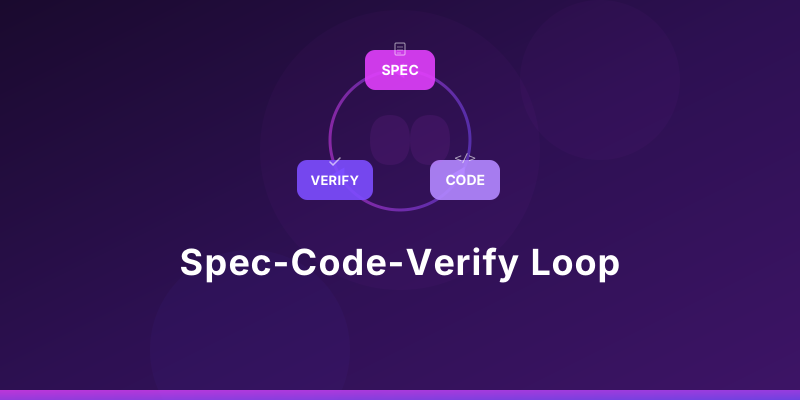
Software development has always been cyclical — write, test, fix, repeat. But the emergence of AI agents introduces a fundamentally new cycle: Spec → Code → Verify. This loop represents a paradigm shift in how software is built, where human intent drives machine execution and automated verification closes the feedback loop.
The Three Phases
Phase 1: Spec
The developer writes a specification that describes the desired behavior, constraints, and acceptance criteria. The spec is the primary artifact — it captures what the system should do without prescribing how.
A good spec answers these questions:
- What does this component do?
- What are its inputs and outputs?
- What are the constraints and invariants?
- What should happen in error cases?
- How do we know it’s correct?
Phase 2: Code
An AI agent consumes the specification and generates an implementation. The agent brings knowledge of programming patterns, libraries, and best practices. It translates the what into the how.
This phase is where the leverage of AI agents becomes clear. A specification that takes 30 minutes to write might describe a component that would take a full day to implement manually. The agent compresses implementation time dramatically.
Phase 3: Verify
The generated code is verified against the specification through a combination of:
- Automated tests derived from the spec
- Static analysis checking types, contracts, and constraints
- Human review for architectural fit and non-functional requirements
- Runtime validation in staging or preview environments
If verification passes, the code is accepted. If it fails, the loop continues — either by refining the spec (if the spec was incomplete) or by regenerating the code (if the implementation was incorrect).
How It Differs from TDD
Test-driven development (TDD) follows a Red-Green-Refactor cycle:
Write failing test → Write minimal code to pass → Refactor
The Spec-Code-Verify loop shares TDD’s emphasis on verification-first thinking but differs in key ways:
| Aspect | TDD | Spec-Code-Verify |
|---|---|---|
| Primary artifact | Test cases | Specification |
| Who writes code? | Human developer | AI agent |
| Granularity | Method/function level | Feature/component level |
| Iteration speed | Minutes | Seconds to minutes |
| Verification scope | Unit tests | Tests + analysis + review |
The SCV loop operates at a higher level of abstraction. Instead of testing individual methods, you’re specifying and verifying complete behaviors. This doesn’t replace unit testing — it layers on top of it.
A Worked Example
Let’s walk through a concrete example: building a rate limiter.
Step 1: Write the Spec
## Rate Limiter

### Behavior
Implement a sliding window rate limiter that tracks requests
per client IP address.

### Configuration
- window_size: duration (default: 60 seconds)
- max_requests: integer (default: 100)

### Interface
- check(ip: string) -> {allowed: bool, remaining: int, reset_at: timestamp}
- reset(ip: string) -> void

### Requirements
- Thread-safe for concurrent access
- Memory-efficient: clean up expired entries
- Time complexity: O(1) for check operations
- Must handle clock skew gracefully

### Edge Cases
- First request from a new IP is always allowed
- Exactly max_requests in a window should be allowed
- Request max_requests + 1 should be denied
- After window expires, full quota is restored
Step 2: Generate Code
The AI agent reads the spec and generates an implementation — perhaps using a sorted set to track timestamps, with a background cleanup routine for expired entries.
Step 3: Verify
From the spec, we derive verification:
def test_first_request_allowed():
    limiter = RateLimiter(max_requests=5, window_size=60)
    result = limiter.check("192.168.1.1")
    assert result.allowed is True
    assert result.remaining == 4

def test_at_limit():
    limiter = RateLimiter(max_requests=2, window_size=60)
    limiter.check("10.0.0.1")
    result = limiter.check("10.0.0.1")
    assert result.allowed is True
    assert result.remaining == 0

def test_over_limit():
    limiter = RateLimiter(max_requests=2, window_size=60)
    limiter.check("10.0.0.1")
    limiter.check("10.0.0.1")
    result = limiter.check("10.0.0.1")
    assert result.allowed is False

def test_window_expiry():
    limiter = RateLimiter(max_requests=1, window_size=1)
    limiter.check("10.0.0.1")
    time.sleep(1.1)
    result = limiter.check("10.0.0.1")
    assert result.allowed is True

def test_thread_safety():
    limiter = RateLimiter(max_requests=100, window_size=60)
    results = parallel_execute(
        [lambda: limiter.check("10.0.0.1")] * 200
    )
    allowed = sum(1 for r in results if r.allowed)
    assert allowed == 100
If all tests pass, the rate limiter is verified. If the thread safety test fails, the agent regenerates with explicit locking. If the spec didn’t mention thread safety, we’d discover it during review and update the spec.
The Economics of the Loop
The SCV loop changes the economics of software development:
- Spec writing is high-value human work that AI can’t fully automate — it requires understanding business context, user needs, and system constraints
- Code generation is increasingly commoditized — AI agents can produce competent implementations from good specs
- Verification is partially automatable but requires human judgment for architectural and design decisions
This means the highest-leverage activity for a developer shifts from writing code to writing specifications and reviewing generated code. The bottleneck moves from implementation capacity to specification quality.
Making the Loop Faster
Several practices accelerate the SCV loop:
- Template your specs: Create reusable templates for common component types (APIs, data models, workers, etc.)
- Automate verification: The more of the verification step that’s automated, the faster the loop turns
- Cache intermediate results: If only the spec’s error handling section changed, you might not need to regenerate the entire implementation
- Parallelize across components: Different components can be in different phases of the loop simultaneously
- Tighten feedback: Show verification results immediately, not in a batch at the end
Conclusion
The Spec-Code-Verify loop isn’t just a process improvement — it’s a fundamental rethinking of who does what in software development. Developers become architects and reviewers. AI agents become implementers. And specifications become the connective tissue that holds it all together.
The developers who master this loop will ship faster, with fewer bugs, and with better documentation than those who continue writing every line by hand. The loop is the future of software development — and it’s available today.
Responses
Want to leave a comment? Visit this post's issue page on GitHub (you'll need a GitHub account. What? Like you already don't have one?!).